Monday, August 5, 2013

Homeless in Fresno

Sunday, July 28 - Fresno

I got into Fresno absurdly early. It was 6am. I had a seven hour layover. It was empty. Heavens to Mergatroid it was empty. It was like an episode from one of those "The World Without People" shows that were such a big fad a couple of years ago. National Geographic did one. BBC America did another. The Discovery Channel did one, too. Even the History Channel got in on the act, albeit with really cheap CGI effects.

I never quite got the lure of all that. What was the didactic purpose of this kind of show? Was it a gentle reminder that all human beings shouldn't just up and leave the planet and our pets behind one day? Was it a warning to God not to rapture off the lot of us without first bestowing toolmaking skills and opposable thumbs onto the housecats? I never considered the spontaneous removal of 7 billion people to be much of a realistic concern. But at least I do know now that, if all human beings up and vanished one fine Sunday morning, the Earth would look a lot like Fresno.

Life has not been kind to Fresno. The people at the station seemed sad all the time; no one smiled. None of them cared to engage in a conversation, assuming they possessed the skills to do so. Fresno is where boring people come, or at least where interesting people get away from. In addition to being utterly bereft of the cultural distinctiveness that the rest of California displays, the economy is, apparently, utterly down the tubes. Many of the storefronts downtown were shuttered. Sometimes whole buildings appeared abandoned. And for a small city, Fresno seemed to have an unusually large number of homeless people—exclusively homeless men—waking up in the park and milling about.


The first guy I saw showed every sign of having died. He laid face flat on a grass island in downtown's open air mall. He didn't seem to breathe. A bird landed near him and flitted away, as if repulsed. Nearby homeless guys who looked new to the roofless life, judging by their grooming, ignored their prostrate compatriot. Only the faintest flicker of his lips up close revealed him to be a heavy sleeper. He smelled of stale Mad Dog, not death. Later in the morning a city grounds crew showed up to operate loud machinery next to him. They ignored him, as if he were a fixture in the mall. He never stirred from his coma.

The other homeless men were awake by 8am. Like California, they lacked any ethnic majority. Most were cleanish, considering their circumstances. Two huddled over a weak drinking fountain and scraped safety razors across their stubble. It was Sunday; gotta look your best. They sat in a semi circle, talked small, and watched the sunlight creep down along the few tall buildings. These were the first people in town to give me actual smiles when I offered them my signature Buckaroo "Howdy®."
(NB: It is delivered with a nonchalant earnestness, an imperceptible bob of the head, and a subtle crinkling of the lower lip, as if to indicate equal parts engagement and detachment. Although its etymology runs from the "How'd'ye do" noted by Frederick Law Olmstead in his 19th Century travel journals through Texas prior to the Civil War, the Buckaroo "Howdy" is discernibly a salutation only, and not an invitation to expound upon just how well you are doing. The homeless men of Fresno seemed instinctively to get that, or at least didn't want to talk to me.)

Click to read the signboard
 An itinerant preacher came into the city mall. He took over a concrete platform in the middle of the mainway and put up a video camera before launching into his sermon. No one gathered. He talked about aliens and UFOs. He held up a chart on a signboard that delineated precisely which Caribbean nations corresponded to each of the sons of Isaac ("Simeon = Dominicans; Levi = Haitians; Asher = Uruguayans" et cetera). When I stood in the middle of his nonexistent congregation and aimed my camera at him, he paused from his discourse on chemtrails poisoning the manna from Heaven, broke his gaze from the video camera and huffed, "No pictures." I think the irony of his request escaped him. The dapper homeless guys ignored him. The orange vested city workers gave him wide berth.


As the homed residents of Fresno broke from their slumbers and began to filter into the city, the homeless disappeared, filing off one by one like movie extras. They surrendered their only home to the four-walled Americans. Perhaps their presence offended them, perhaps they were responding to that vestigial migratory call that had rendered them homeless in the first place. We're all the children of nomads, after all. Who's to say being sedentary isn't the aberration? How can we be sure the perversion doesn't lie in having good hygiene and being well rested in the morning?

By 9:30am a smattering of shops we're opening up. The birds left the ground and moved up to the trees and building tops. The pictophobic reverend folded up his camera and tripod and withdrew from the human commerce. Well dressed ladies and gentlemen crossed the mall heading off toward their churches. The last of the homeless men were swept away with the tide of respectability. Only the not dead drunk guy splayed on the grass gave witness to the night's inhabitants.

It was a sunny Sunday morning. It was time for me to find a church.

Sunday, August 4, 2013

Things you notice when you're bored

July 26-30 - Bus stations

This journal is supposed to be about the places I go, not the way I get there. Obviously this is an artificial distinction. Getting there is almost half the journey, if you don't count getting back. But I find myself comparing the Greyhounding experiences from town to town.

I started out last week opining how San Antonio's bus station is a police state and El Paso's is a model of customer service. Not being a bus travel aficionado, I'd assumed at that point that I had pretty much run the gamut, from good to bad, in the taste bus stations come in. But nope, there's a Baskin Robbins of bus stations out there in America. Let me give you the scoop. Ha ha, see what I did there?

Well, if San Antonio is 1984 and El Paso is big welcome hug, Phoenix's bus station seemed like a post-apocalyptic nightmare. Refugees scattered about the floor, sleeping, looking befuddled, starving in the night. A few of them were clearly contemplating cannibalism if it came down to survival—perhaps sizing up the old, perhaps sizing up the young. Bands of aggressive youths cruised through like sharks scouring for prey. Officials barked orders at lines of passengers, rearranging them like baggage.

El Paso, with people smiling and offering to watch one another's children when their youngest needed to be taken to the restroom, was a distant memory. In Phoenix moms snapped "Just hold it till you're on the bus" at their bouncing toddlers and clutched their check on baggage in fear. Instead of San Antonio's blaring big brother TVs, all the sets in Phoenix were locked down and broken. No one had gotten around to starting a fire in one yet, but this was the next logical step before people started ripping up the metal benches and sharpening the armrests into shivs.

It was a relief at last to come to Los Angeles. The entertainment capital's bus station was all business, slick, and corporate. It was El Paso without the charm. Customers were serviced without the inefficiency of camaraderie. When my bus was reported running 30 minutes late, the ticket counter lady offered me free food voucher. Her smile was all business, unintrusive. The ubiquitous American TVs were there, but didn't dominate the room. There was plenty of room for thinking, reading, or talking small with a stranger. A conversation ran philosophical and the mom from San Diego was willing to follow along. When she turned the question around and asked me what I thought it meant to be an American, I could only think of positive things to say.

Fresno was an abandoned building, a desolate, hopeless, pre-industrial abandoned building. God help you if you ever get to Fresno.

Friday, August 2, 2013

Hollywood!

Saturday, July 27 - Los Angeles

Hollywood.

It gives me writer's block.

I trundled into town detached, as if traveling along the pilgrimage route to another tribe's holy city. Hollywood, the glamour capital of America, celebrityville, Hollywood, the cultural hearth of post literate western society, home of first name only celebrities. Hard as I try to be above it all, I came to Hollywood and gawked like rube.

I got into Los Angeles and called a cyberfriend, Dennis, who'd graciously volunteered to show me the cultural highlights of his city. We'd never laid eyes on one another so I tried to make myself more identifiable at the bus station.

"I'll be out front," I told him, "I'll be the one wearing a black shirt."

"This is L.A., dude. Everyone's wearing a black shirt."

This is the first thing I noticed about Los Angeles: everyone's trying to live up to the stereotype. Rockers in the street dressed completely like rockers—black shirts, shaggy hair, jeans ripped and safety-pinned together. Actors shamelessly mugged in ill-fitting superhero costumes along Hollywood Boulevard. Explosions of community murals and colorful street art and deco-funky buildings and Latino-flavored open air markets that lay out every hue of the Southwestern palette and vintage 30s cars cruising in mint condition and In-and-Out Burger joints and seedy freeway underpasses and puddly concrete reservoir basins from a hundred Hollywood car chase sequences. Every street corner and every camera shot passing view in Los Angeles is an amped up version of exactly what you expect it to be from TV shows, talk show hack jokes, Us Weekly photo spread, and pulp detective novels. City of Angels, City of Paparazis, City of Stars.

The thing is, all the hackneyed pop cultural references made me expect Los Angeles to be a heartless place where the final western progress of American society landed, chewed up culture, and spit out damaged people in search of quick bucks and transitory fame. But on cruising through the city with an instantaneous good friend, I got a wholly different impression. Instead of consuming culture and leaving behind a dry husk of glitter and profits, I found a community so hungry for culture that it was in a constant state of reinvention. Los Angeles is still a fresh college graduate, starting on a new life and maybe even looking for a friend.

Los Angeles, having tired of its reputation as a car-cruising wasteland, has reinvented itself as a mass transit friendly modern city with a state of the art subway system. But it doesn't look inexperienced or utilitarian as you'd expect a new subway system to appear. When LA built its subway, it erected a series of user friendly, aesthetically pleasing, and artistically impressive stations train stations up and down the cultural highlights of the city. From the film noir Modern eloquence of Union Station to the Forbidden Palace arches of Chinatown's station to the retrotech homage of the station that fed us into Hollywood and Vine, the subways were roomy without being cavernous and efficient without being rushed. They were artistic, urban, and clean.

Dennis took real pride in his city, chauffeuring me about through a busy street market full of quick tacos and gaudy souvenirs, past a street festival with Mexican folk dancers regaling a crowd, up and down Hollywood Boulevard as we laughed and pointed at each brass plated movie star's name we recognized, each name a mini shrine to yet another minor saint in the American religion of show biz, each side shop a treasure trove of false relics revering our faith in glamour and fame. Americans grow up expecting to be famous, expecting to be stars one day, just as Medieval serfs grew up in their manorial fiefdoms expecting to go to Heaven once they died. Stardom is our cultural birthright and our salvation. Los Angeles, our Rome, has simply made a working business out of proselytizing this faith; it is as efficient as the Vatican and just as pure in its motives. Hollywood gift shops are simply how we revel in this American faith in show biz: Three Stooges tee shirts, Humphrey Bogart shot glasses, Marilyn Monroe coffee mugs, snow globes incongruously trapping the Hollywoodland sign in the swirl of a violent blizzard. It's only unseemly if you're one of those pagans who don't like summer blockbusters.


A drag queen dressed like Cyd Charisse sashayed onto the subway, nonchalantly gazing about for admirers. Kids rented long stretch limos and cruised up and down the Walk of Fame like movie stars. I only know they were kids because I craned my neck down to look in and see if there was anyone famous in there. Nope, just kids. Musicians walked along swiftly in dark shades as if to avoid their imaginary fans. Ludicrous middle aged businessmen paraded their trophy wives past Grauman's Chinese. Paparazzi set up cameras on tripods in front of the Grauman's, waiting for celebrities who never arrived. Dennis never gets tired of it. The people here live in the art of constant reinvention.

Dennis has worked as a navy seaman, a financial analyst, a noodle chef, a commodities broker. He's tried out for movie parts. Now he's a truck driver. He's reinventing himself, too. It's what people do here. It's what people can do here. It's the land of reinvention. People just become what they want to be. They might spread our culture around, but they don't let the past hold them back. Four hours in the man's company and I feel like I have a lifelong buddy. Perhaps we just wanted that; perhaps we just invented that idea.

It might be L.A., but I really wouldn't call it la-la.

Monday, July 29, 2013

Travelers

July 26-27 - on the road

The one thing I like about the bus is that you get to talk to people. These are real people, getting around on a budget. I talk to a Lebanese truck driver from California. He's down on his home state. California is driving independent truckers like him out with their pollution regulations. He says LA is bad, pollution wise. He wants me that when we go over the mountain into LA, to expect a broad yellow smog to cover the city below. Still, the pollution cleaning devices the state is requiring all trucker to put on their vehicles cost about $14000. He can't afford it, so he and his wife are moving to San Antonio, where you can still make a buck.

I talk to a 40ish hippie lady. She looks road worn and not entirely there. She's from Tempe. She's spent the last 10 years in Florida waiting tables. She's wearing a huge back pack when she gets on the bus. I ask her if she's a experienced traveler. Surprisingly, she says no. She'd hitched east in late 90s to get out of Arizona. She's going him to take care of a sick friend. She says that like it's a surrender.. She packs like that cause she likes camping. But bus riding isn't camping; you have to pack light, not tall. The bus is hard on her and the cramped seats make her fidget. She gets off in El Paso and determines she'd rather hitch her way back to Arizona, even if it takes longer. She looks like she's spent a lifetime taking the harsher route.

The bus stops in Blyth, California for a 30 minute lunch break. A McDonald's and a Taco Bell are one block from the bus stationette. Two guys named Manuel and Carlos walk with me three blocks further in the dry midmorning heat to taqueria across the freeway. The food there is just like Taco Bell, but we feel better for our efforts at authenticity. I ask Manuel if Carlos is his nephew or his son. "No, we're just friends. We're both from Corpus and we're heading home California." Manuel is much older, at least late 60s, dark skinned with a salt and pepper beard, long and scraggly like an Indian's. He's buying Manuel's lunch. When Carlos brings the food back from the counter, Manuel tells us about a time he was young and penniless and some guy bought him lunch, only making him promise that someday, if he met someone in need on the road, he'd have to help him out. He makes Carlos promise to do the same once he has money. Carlos is in his 20s and eagerly takes this bargain; he can't imagine not having lots of money one day.

Manuel talks about his 27 years in the army. He's seen the world, starting with Vietnam, but no one place is his favorite. He says he might be going senile. He has 9 siblings back in Modesto. Everyone but me on the bus seems to be going home.

Gina is 16 and is traveling with her mother, who doesn't at first appear to speak English. They're returning to San Bernardino from visiting relatives in Taos. When we pass a huge wind farm out of Indio, California, she looks at the massive three blade propellers karate chopping the wind to harvest its energy. She says, "I want to be an engineer one day and work on them." I tell her that's a good goal; that's the future. "Well, if I can go to college," she adds on. "No," her mama interrupts in a heavy NorteƱo accent, "you weel go to college." Good for you, mom, I nod. The conversation has reached a comfortable end point and the ladies go back to watching their movie on Gina's laptop.

I probably look like a goober taking pictures of mountains out through the bus window. I don't care. I'm still blown away at the sight of the western mountains this up close. I embrace my goofiness.

Up and Down America

Friday, July 26 - New Mexico

I'm a flatlander. I don't apologize for that. Flattened lands, terrain without contours, a country with distant horizons, this is my comfort zone. I don't understand mountains.

I've been through the Appalachians a few times in my life. When I was a kid my family would drive east to visit relatives most summers, but those are friendly mountains. They ease you up into their heights with the rolling hills at their feet and give your ears a chance to slowly adapt to the lighter air pressure. They cover their naked elevation with a coy draping of trees. As you climb them, there is greenery and the hint of active fauna to make a human-friendly environment. They're not flat, but at least the eastern mountains don't throw their looming altitudes in your face.

These western mountains, however, seem to pop up out of nowhere. This struck me as I drove east out of El Paso and saw wide gray mountain ranges fade in all along the horizon. No sooner had they appeared, still 20 miles in the distance, but they raised the arc of the horizon at least 15 degrees higher. Soon clumps of smaller mountains rolled into view to the left or right, rocky and steep, but clearly inferior to the growing mountains ahead.

The ground level itself rose only slightly, judging from the occasional pop in my ears, before these great jagged walls came into full view. Road signs eventually named the Guadalupe Mountains. Their jagged rise and treeless slopes and scattering of boulders about tell a story of violent tectonics below, eons ago, convulsing the earth and giving birth to these giants. I drove into them wide eyed and dumbstruck by the steep faces and vestigial rockslides still gathered at their feet.


These are monsters made of rocks, surrounded by dramatic vistas and dangerous avalanche zones. They have a scattering of shrubs and desert plants on them, in spots, but not the full beards of green you see back east. These are adolescent mountains, patchy in their foliage, still awkward, and prone to tantrums. And yet to us, they are like gods. My car brought them onto me faster than the first humans could fathom, but even that advance of human mobility couldn't tame the awe the Guadalupes command.

Cars, like most technologies, try to make us love God less. But the Guadalupes mock technology. You can't help but approach and enter those mountains and not fall silent at nature's might. Paved roads that slice through the deserts have to bend to accommodate mountains of this rise and girth. Wending between two rocky clusters of sharp mountains, my eyes darted up left then up right toward the tops of the spires. I couldn't not look.

Circumnavigating the first peaks, a new clutch of mountains appeared around the bend. I was in a valley of giants, my mouth agape like a suckling infant. I felt small, but safe between the spiring rocks. The things that worry me didn't matter up here. Drunk drivers, angry strangers, shrinking bank accounts, and temperamental artists don't matter. Threatening bosses, rising insurance payments, self destructive friends tumbling drunk off balconies, capricious utility companies, manipulative politicians, and the slow creep of environmental destruction all lost their grip on my shoulders and fell away.


These mountains will endure the loss of all we know. The weight of being in debt, of being powerless, of not being good enough all fell away. Human things didn't matter in the high mountain air. We're just here while we're here and then we're gone. Only these rocks abide. The scope of the mountains shrunk my worries and fed me and made the world safe for one afternoon, even as I flew on black rubber through the falling rocks zone. The mountain air lightened all worrisome things and lifted them into the clouds. I cried at the sense of relief in these mountains and then laughed at how silly it was to cry about mountains.

But there's something bigger than human cares up there. For a second I felt it.

Beyond the Guadalupe Mountains the road persists into Carlsbad. I didn't have to use my turn signal once. Unlikely as it sounds, it's all just one street from the Coral Motel to the tourist traps outside the Carlsbad Caverns.

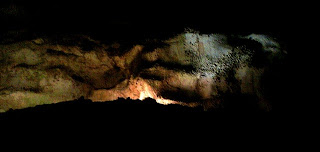
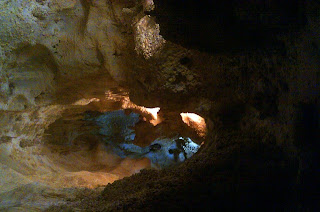
The natural entry into the caverns is a looping, dropping path down into the earth. On a hot day, the cool of the cave radiates off the dank walls as your feet tack you downward into the planet. Park rangers warn tourists about bats and not touching the stalagmites. But today there were only song birds chirping wildly and fluttering in and out of the cave's mouth. There were a hundred birds from several different species, each physically small—either because deserts keep their residents small or because the mouth of the cave was so large.


The park rangers do not warn guests about heavy scent of guano—bat poop—rising out the throat of the cave on the warm air of human tourists. For forty five minutes, you just walk down and down more, weaving like a doodle, into the dark cool. Eyes adjust as the indirect light above dissipates behind you. The occasional electric spotlight casts reliefs onto walls and triangular shadows onto the ceiling of the cave.


A sign along the path warns hikers not to touch anything off the pathway, not to make too much noise, not to drop trash that will stench up the cave pools or attract vermin. In other words, don't be too human. You are but eyes here, and you are ears to the quiet, if you can get away from others on the trail, and you are body heat that the rooms of the cave will push out to keep the balance. But you are nothing else.

Another sign further down makes it clear. Do not enter the deep paths in the cavern after 4:30pm. Do not remain anywhere in the caves after 5:30. They do not mention the government's secret treaty with the Mole People that allows them to carry off whoever they find after 6pm. But it is implied. This is not where you belong. Stay on the narrow path. Do not tire down here. We are not responsible for you.


Perhaps I've read too many pulp stories to be impressed by dungeony underground lairs. Bodies of stalagmites and collapsed boulders carry impressive names. The Dolls' Theatre, Iceberg Rock, the Whale's Mouth, the Twin Domes, the Hall of the Giants. I couldn't help but notice the obvious omission. The domes and minarets of mineral formations all have a distinctly phallic appearance. Perhaps God's great claw carved out these cathedrals and throne rooms from the Earth for us to explore. But before the apes shed their hair, naughty rock appendages rose out of the cavern floors and flagged down from the moist, spent ceilings. These are the halls of the penises. This is not Plutopolis; it is Priapusville.

For a change of pace, a giant nipple
Eight hundred feet down human commerce stops. It took me almost an hour to cover the length of less than two and a half football fields. At times I had to walk backwards, like an acrophobe, just to shift the pressure off my ankles and onto my calves, both of which had an easy time of it. Another hour of milling about at the lowest, and most impressive, levels and I was overnourished on nature's beauty. I had a bus to catch back in El Paso. There's an elevator now that comes down to the 800 foot level—where Eisenhower and Krogthurgnert signed the secret treaty they don't tell you about. I gladly hopped on and shot back up to the human world. I bought a commemorative shot glass at the gift shop and drove away.

Saturday, July 27, 2013

El Paso

Thursday, July 25 to Friday, July 26 - El Paso, Texas

Sign of motel I don't wanna stay at, no matter how much I'd like to use a microrfidge.


I love El Paso.

The Coral in Its Heyday
I ended up in a bungalow style motel from the 1950s (at least) called the Coral Motel. It's an odd choice of names. I can't imagine there was ever much coral in far west Texas. It doesn't seem to be a misspelling of corral. It was different in its heyday, of course. The interior wasn't designed for as many outlets as contemporary travelers expect. In one corner of my room, a small microwave and a half-sized fridge shared an old brown powerstrip to jack into the wall. The microwave needed an adapter so that its three-prong plug could work with the two-prong power strip.

Modern conveniences struggled to bridge a technology gap two generations thick. No one planned ahead for the future to show up at the Coral Motel. It just showed up one day, many days, one invention at a time, and the rotating cast of managers shoved things around to make room.

The Coral Today
Half the accommodations in the room looked jury-rigged; the room has been updated on a strictly ad hoc basis. The shower head had a bizarre looping design from the 70s. The brown power strip was from the 60s. The microwave was at least 20 years old; the television at least 30. The fridge was brand new. It was not a microrfidge. The wall paper pattern was a shout out to the orange and avocado 70s; the bathroom sink looked like it was installed at the time of construction. Nothing, apparently, was thrown out until it quit working.

The accommodations didn't matter much, actually. I wasn't going to spend time watching HBO. I had a narrow window to look up Friday's travel plans, find something artsy or cultural to do in El Paso, type out a couple of journal entries, and swap emails with my people. But my primary mission was to spend some time not on a bus.

El Paso, or at least what I saw of it, is clean city. It's small, but struggling to have an arts scene. I missed the "Last Thursday" gallery stroll, but caught a couple of jazz sets at downtown bars. I was directed to Cincinnati Street for the best restaurants in town. There I had my best conversation in El Paso. Her name was Mercedes.

I found a bar and grill on Cincinnati that looked sufficiently El Pasoish and took a stool at the bar. I chased two pepper hot fish tacos down with a pair slightly dirty martinis—house vodka, of course, cause I ain't no James Bond.

Mercedes manages the bar and grill for her brother, the owner. She has a striking face and silver-streaked dark hair. She carried herself with the casual manner of an artist—I later found out she's a painter. Our conversation stretched out over an hour and a half. Of course when you travel, you rarely talk to anyone for more than an hour. There's always somewhere else to be and something else to take in. I don't think I quite captivated her, but every advance in our dialogue was interrupted by yet another customer needing attention or a waitress presenting another problem.

Mercedes as manager wasn't the boss-type. She was more like the mama of the waitstaff and kitchen crew. She mothered rather than ordering her crew around. She solved their urgent problems with suggestions instead of solutions. Everyone was hurried, but none of her people were frantic. Her calm was contagious.

"So, your brother owns this place?"

"Oh yes. He brought me back from California to run it... and also to help take care of our dad. He's ninety and still sharp as a tack. But of course he needs help to get around and manage things."

"What's it like working with family?"

"It's really not bad. In fact, I treat everyone here like family." She smiled at a waitress bringing a cake out. Suddenly the whole waitstaff converged on one of the cooks and sang him "Happy Birthday" with real warmth, not the manufactured birthday songs chain restaurants bombard customers with. The whole restaurant applauded and in seconds the crew had dispersed back to their stations.

Mercedes seemed to glide from spot to spot about her restaurant, sometimes appearing without warning right next to me and picking up our conversation where we'd left off. She was ethereal, nurturing her workers to handle their jobs cheerfully, never issuing orders. In a word, it was feminine power, delegating from the center out, rather than from the top down. The crew worked together, not like a well oiled machine but like a river, surging and ebbing in waves to meet their purposes.

Her crew included her daughter visiting from San Francisco. "Whenever she comes down," Mercedes explained, "she gets to pick up a shift here and earn a little money for school." The verb stood out. She didn't have to pick up a shift, she got to.

Her current art project, she told me, involved painting a portrait of a baby-to-be on the plaster cast of a pregnant mama's belly. She kept steady eye contact without staring. She listened with her whole body. She rifled through El Paso's arts weekly with me, directed me to stay long enough for a free downtown concert Friday evening, the Alfresco Fridays music series. She wanted to show off El Paso, her El Paso, like she had nurtured it herself from its infancy. No, she said, she couldn't make it to the concert herself; she had to work Friday. She was so smooth and gentle about it, I didn't even realize until an hour later that she'd shot me down.


After talking to a few locals Thursday and Friday, I saw what a family town El Paso is. A small city trying to fill the geographic shoes of where a big city should be. They make up for their size by pulling together. One bar worker graciously recommended a different venue. The old buildings of old downtown stand proud and undemolished—shocking to a Houstonian. The low rung worker, a car washer, at the car rental place who drove me back to the Greyhound station talked with equal enthusiasm about the city's new Triple-A ball club and the old and new museums El Paso offered. It didn't feel like salesmanship as he described the new stadium under construction. It felt like family pride.

Friday, July 26, 2013

Juan

Thursday, July 25 - lunch stop in Fort Stockton, Texas

Sturdy dude, about age 25, with arms full of tats, a neatly trimmed full goatee with pencil thin moustache, and a black baseball cap turned sideways. Looks a little bit chollo.

Dude: Hey, is that a good book?

Nerd, late 40s, absorbed in reading a book in the children's play area of the bus station Mickey D's because screaming brats are less annoying than "The View" on widescreen TV

Bucky: (closing book to show cover) Yeh, it's pretty good. It's about the decision to drop the Bomb on Japan in World War Two.

Dude: Oh yeh, we studied that in school. That was kinda fucked up.

Bucky: I guess. It was a war.

Small talk occasionally interrupted by screaming children falling off the tube maze. The young dude keeps steering the conversation back to war.

Dude: Yeh, war fucks things up. You ever been in a war?

Bucky: No. I'm a teacher. A lot of my kids joined military.

Dude: How you feel about that?

Bucky: I dunno. It's complicated. I mean, you see some kids, they really need the discipline. And they get something. They grow up faster, or maybe catch up growing. But, you know, all the wars these days.

Dude: Yeh. That part sucks.

Bucky: You ever join the army?

Dude: Naw, I'm a barber. I cut some guys' hair. Some marines, you know?

Bucky: Oh sure. They're always the hardcases. They're the ones with the most discipline, you know, based on what I've seen from my students when they come back to visit.

Dude: A lot visit you?

Bucky: A few. One of my ex-students came back from Iraq, and he was pretty messed up. He'd killed a young kid at a checkpoint once... and he found out later that little kid was his little brother's age. Fourteen. That messes up your mind.

Dude: (nodding) You know, the Japanese bombed us at Pearl Harbor. And then, later, we dropped a couple of Bombs on their cities, and that ended it. But then, after Nine-Eleven, we got bombed... and we went over there. But we didn't drop any A-bombs on them. And now that's still going on.

Bucky: Well, it wasn't quite that simple back then. They didn't know that dropping the Bombs would end the war. They were still gearing up for an invasion, and they were hoping, the generals were, that they could use the A-Bomb against the Japanese armies, and then send our guys in after a few days to mop them up. That was their plan.

Dude: Just a few days? That's fucked up too.

Bucky: Well, they didn't know much about what radiation could do.

Dude: But still, treating their own people that way... (pauses) But you know, the Bombs still ended the war.

Bucky: That's what us teachers are supposed to teach you. But that's not really the whole story. The Japanese were really ready to fight on. They were fascists and they didn't care that much about their own people dying.

Dude: But they surrendered.

Bucky: They surrendered cause they were afraid of the Russians. They didn't want to be occupied by the Russians, so they gave up only to the Americans.

Dude: Oh.

Bucky: You have friends in the army.

Dude: Not the army. My wife is in the Marines. She just signed up for another hitch.

Bucky: Wow.

Dude: She just made sergeant.

Bucky: She must be doing pretty good.

Dude: Yeh, I guess. She's real eager to go fight, you know? I tell her she oughta look for a desk job, but she wants to get in there.

Bucky: She's in a combat unit?

Dude: Not yet. But she wants to go. A lot of the Marines, I cut their hair, and they like want to go get into it. Fight and kill and all.

Bucky: You don't sound too up on it.

Dude: No. look, I support her and all. This is her life and I guess the Marines treat us pretty good. But our new base, there's not as many Marines there, so my business is pretty slow now.

Bucky: Do yall ever stay stationed long enough for her to take classes?

Dude: Oh, that doesn't matter. She mostly takes those online classes. She'll get a degree out of this. But, you know...

Bucky: You worry?

Dude: We got three kids. I'm having to take off to work with my cousin for a couple of weeks, just to get some extra money. He's got a construction business.

Bucky: She's deployed now?

Dude: Not yet. She's watching the kids. We don't know when she's gonna go back over. She's done two tours.

Bucky: And she upped for a new enlistment.

Dude: While she was over there.

Bucky: Afghanistan?

Dude: Kuwait. But she wants to go fight. It's their culture, the Marines. Everybody wants to go kill.

Bucky: Hardcases.

Dude: No shit.

Bucky: I don't think we're going to be over there much longer. Or we're not supposed to be.

Dude: That's what I was saying. If we had just dropped the Bomb on them, it would've been over.

Bucky: I think that mighta caused more problems than what we've got now.

Dude: I don't know. I think it needs to be over now.

Bucky: Amen. Of course it's always more complicated than that. There's always gonna be something going on somewhere in the world. You sound like a good father.

Dude: Thanks. (thinks quietly) No, that shit just needs to be over with.